
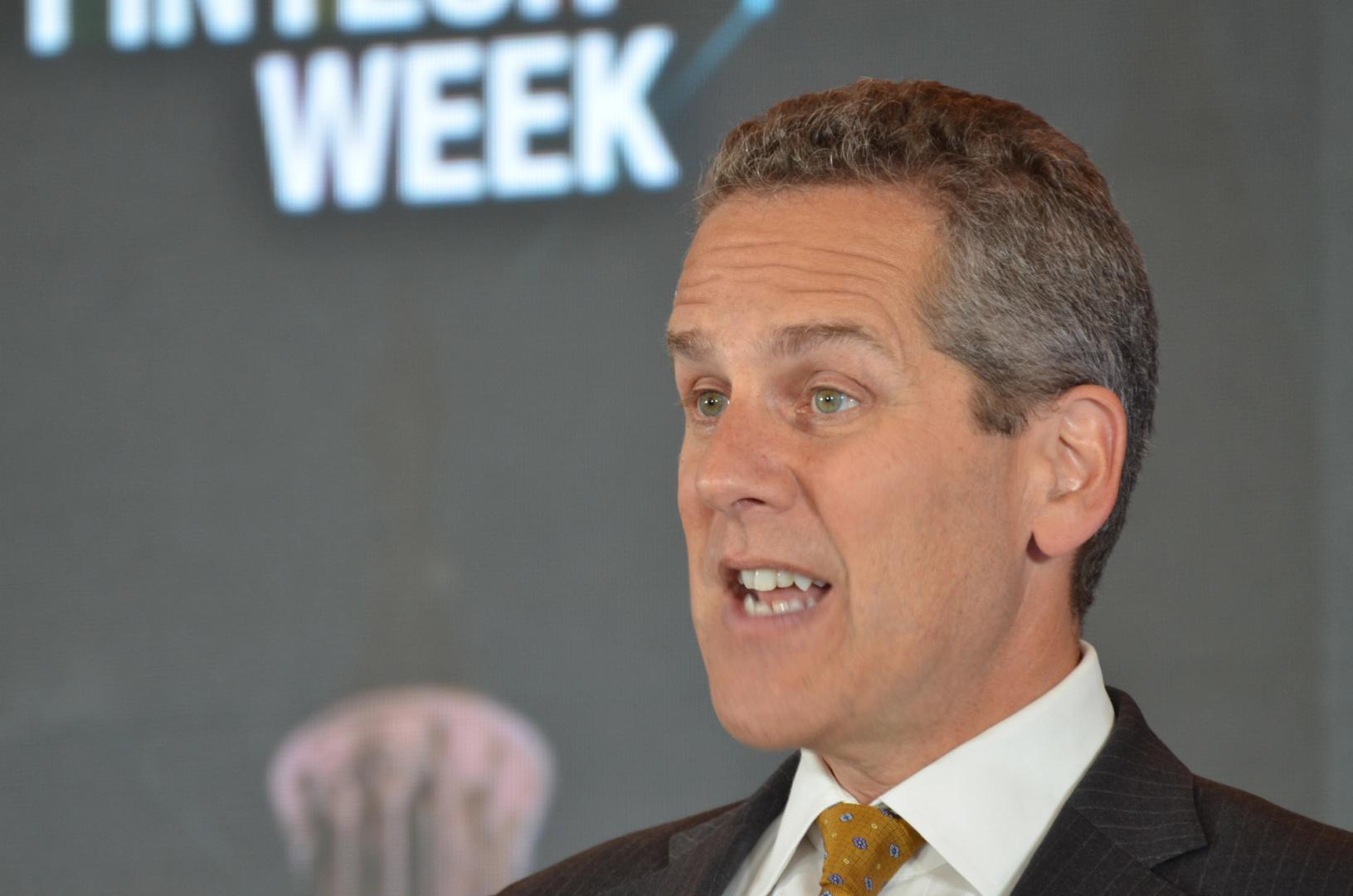

WASHINGTON, D.C. — The crypto sector and a number of the monetary giants on Wall Road are sprinting to place stablecoin infrastructure in place effectively earlier than the U.S. watchdogs arrange their rules, and Federal Reserve Governor Michael Barr took a second on Thursday to remind the business’s authorized consultants of the hazards posed by nominally protected property.
“Issuing liquid liabilities redeemable at par but backed by assets, even high-quality ones, about which creditors might have questions makes private money vulnerable to run risk,” Barr mentioned throughout a DC Fintech Week occasion in Washington, mentioning that allowable reserves similar to uninsured deposits may pose risks.
He was the Fed’s high financial-supervision official because the board’s earlier vice chairman in that position, however he stepped down when the administration of President Donald Trump arrived. The digital property sector noticed Barr as a part of the “debanking” pattern during which business insiders accused banking regulators of encouraging banks to step away from their companies, and the Fed and different U.S. regulators have just lately reversed the extra restrictive crypto coverage stance they’d taken throughout his tenure.
However Barr stays on the seven-member Fed board and cautioned the companies which are writing stablecoin guidelines — together with his personal — of “the long and painful history of private money created with insufficient safeguards.”
Barr provided the U.S. expertise with cash market funds for instance, noting the Reserve Main Fund “broke the buck” — fell off its $1 worth per share — in 2008 as the worldwide monetary disaster received underway, and the way the newer covid pandemic put stress on such funds once more.
Regardless of the passage of the Guiding and Establishing Nationwide Innovation for U.S. Stablecoins (GENIUS) Act, the banking regulators have not but written the principles they will have to implement it, leaving the business in a type of unregulated grey space. As this continues, the world’s main stablecoin, Tether’s USDT, is run offshore and underneath a reserve strategy that would not qualify in opposition to the pending U.S. normal (although Tether can also be planning a full entry into U.S. markets).
“Stablecoin issuers traditionally retain profits from investing reserve assets and therefore have a high incentive to maximize the return on their reserve assets by extending the risk spectrum as far out as possible,” Barr famous. “Stretching the boundaries of permissible reserve assets can increase profits in good times but risks a crack in confidence during inevitable bouts of market stress.”
“For the most part, I agree with everything he is saying,” mentioned Corey Then, vice chairman and deputy basic counsel for world coverage at Circle, the issuer of USDC, the main U.S.-based stablecoin.
“There’s a lot of work to be done in the rulemaking process,” the Circle government mentioned on the similar Washington occasion, taking the stage simply after Barr. “The last thing we want at Circle is a permissive environment.”
Barr flagged the inclusion of uninsured deposits as potential reserves for issuers underneath GENIUS, noting they have been “a key risk factor during the March 2023 banking stress.” He additionally pointed at so-called “overnight repo” as a reserve element that “could include potentially volatile assets.”
Throughout the 2023 disaster amongst tech-centered U.S. banks, Circle had as a lot as 8% of its reserves at failing Silicon Valley Financial institution, value greater than $3 billion, inflicting a rush to redeem USDC that pushed it quickly off its greenback peg. Different high-profile stablecoins have additionally strayed from the peg, together with within the implosion of Terra’s UST in 2022.
Barr provided a GENIUS Act hypothetical, suggesting that as a result of bitcoin has been authorized tender in El Salvador, an argument may very well be made for bitcoin repo as an eligible reserve asset.
Federal and state regulators want to write down “a comprehensive set of rules that can fill in important gaps and ensure that there are robust guardrails to protect users of stablecoins and mitigate broader risks to the financial system,” Barr mentioned.
Nonetheless, as a result of issuers could also be regulated throughout a spectrum of presidency companies at each the federal and state ranges, he warned of the chance of arbitrage during which issuers store for the best watchdog, regardless of the GENIUS Act’s intent that they be considerably comparable.
Within the 2008 meltdown, American Worldwide Group’s dangerous financial-products arm was famously overseen by a weaker federal regulator — the Workplace of Thrift Supervision — and far of its different operations by a spread of state supervisors, leading to unnoticed hazards that finally threatened the broader monetary system. (The OTS was subsequently disbanded.)
Learn Extra: Tether CEO Says He’ll Comply With GENIUS to Come to U.S., Circle Says It is Set Now


