

Takeru Saito, Japan’s Minister of Financial system, Commerce, and Business, introduced tax reforms supposed to nurture the expansion of startups within the Web3 and blockchain sectors – an indication of Japan’s help for Web3 innovation.
The reforms have been laid out throughout the WebX Convention, Tokyo’s largest occasion devoted to cryptocurrencies. Saito used the event to reaffirm the Japanese authorities’s dedication to making a beneficial setting for innovation. The proposed plan goals to draw worldwide companies and builders, place Japan as a “new” world hub for Web3 developments, and likewise assist the event of startups.
Prime Minister Fumio Kishida envisions the mixing of Web3 and blockchain applied sciences into Japan’s financial and social growth methods which known as “new capitalism”. He considers them promising applied sciences that would assist tackle among the nation’s most pressing social points.
Kishida’s cupboard has laid out a broad Web3 technique, of which this convention was a component, that encompasses not simply financial measures but additionally plenty of initiatives geared toward constructing out the infrastructure obligatory for Web3-related tokens to operate in Japan, in addition to streamlining fee processes involving Web3 applied sciences. The federal government hopes that this may drive innovation throughout a number of sectors.
Addressing Social Challenges By Web3 Innovation
On the WebX convention, Kishida stated that Web3 and blockchain applied sciences are the inspiration for fixing social points, including that the federal government needs to make use of them for one thing past mere financial development. Japan’s embrace of Web3 tech extends to addressing essential social points, particularly in its rural areas.
A placing occasion is the Neo-Yamakoshi mission in Niigata, which reveals how blockchain and non-fungible tokens (NFTs) are being used to revitalize communities affected by demographic decline and financial stagnation.
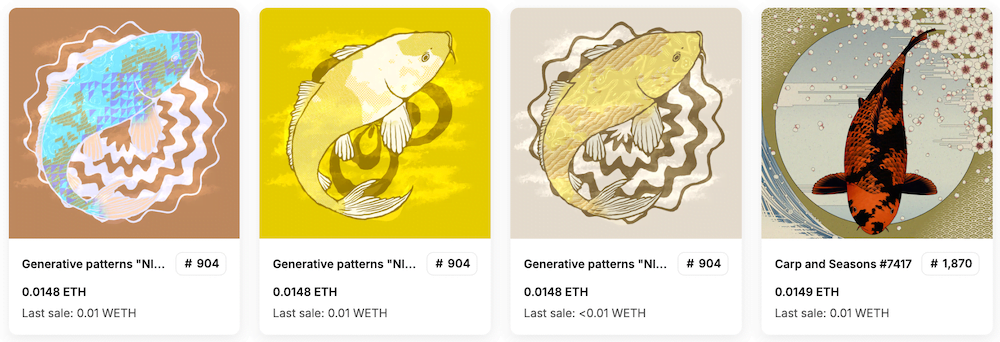
Based in 2021, the Neo-Yamakoshi Village mission established the Nishikigoi NFT assortment, impressed by vibrant koi fish. The Nishikigoi function digital identifiers and governance tokens for the mission’s residents. The mission has welcomed nearly 1,700 digital residents and has accrued over $423,000 to help native growth.
By holding Nishikigoi, supporters might help govern the village’s decentralized autonomous group (DAO) and make selections that have an effect on its neighborhood.
Japan’s Web3 Stance vs. U.S. Regulation: A Diverging Path
The proactive place Japan is taking over Web3 and blockchain know-how contrasts sharply with the regulatory posture in the USA. Whereas Japan works to create an setting that’s pleasant to innovation and makes use of blockchain know-how as a lever to unravel social issues, the U.S. is taking a extra conservative and supposedly protecting method.
The latest motion by the U.S. Securities and Trade Fee (SEC) serves to focus on this. The SEC issued a Wells discover to Opensea, one of many largest NFT marketplaces. The discover means that the SEC is about to take enforcement motion towards Opensea.
In distinction, Japan’s stance reveals a normal openness to undertake new applied sciences and delve into their potential upsides, whereas different international locations wrestle with the regulatory points they increase.
By persevering with to again the Web3 revolution with its tax reform and infrastructure growth, Japan is positioning itself as a go-to place for innovation on this world Web3 scene. The distinction between Japan’s and the U.S.’s embrace of Web3 may properly turn into a defining attribute of how every nation efficiently navigates the way forward for blockchain and digital belongings.
Editor’s observe: Written with the help of AI – Edited and fact-checked by Jason Newey.


